
2026-09-06
Muscle Soreness After a Workout: What Reddit Gets Right (and Wrong)
Is soreness proof of a good workout? We pulled real threads from r/workout, r/beginnerfitness, and r/naturalbodybuilding to sort fact from gym myth.
Read Article
Personal trainer & software developer · 2026-09-22

A beginner calisthenics plan needs four movement categories covered — push, pull, squat, and core — trained 3 times a week with bodyweight-only exercises, before adding any skill work (handstands, muscle-ups, etc.). r/bodyweightfitness's own wiki and the most-shared beginner routines on r/CalisthenicsCulture converge on almost the same structure, built around push-ups, rows or pull-ups, squats, and planks.
Train push-ups, rows (or pull-ups), squats, and a core hold 3x a week, 3 sets per movement, resting at least a day between sessions. Start with easier variations (knee push-ups, inverted rows) if you can't yet do the full movement with good form — Reddit's beginner routines consistently prioritize form over rep count in the first few weeks.
r/bodyweightfitness's own wiki is the most-referenced starting point in this space, and it's explicit about not overcomplicating the entry point: "For absolute beginners, we do recommend starting with the Primer (below), but from there, you can move either to the BWSF or the RR depending on..." your goals and how much structure you want. (r/bodyweightfitness, Wiki: Your Guide to Calisthenics) A specific beginner routine shared and reused across threads breaks down to exactly four moves: "Beginner Calisthenics workout plan: Pull-ups 4-8 reps (1 set), Squats 8-12 reps (1 set), Push-ups 4-8 reps (1 set), Sit-ups 8-12 reps (1 set)." (r/CalisthenicsCulture, "Beginner Calisthenics workout plan")
For a sense of where "beginner" ends, a widely-shared thread on getting started names a concrete milestone rather than a vague goal: "the basics of 12 pullups, 30 pushups and 20 dips in a row. es Push ups Body weight rows Shoulder press. Squats Hip hip extensions Dips. Best..." approach is building toward those numbers gradually with easier variations, not attempting them cold. (r/bodyweightfitness, "Noob Want to start Calisthenics", 80+ comments) That "12/30/20" benchmark is repeated often enough in this community that it functions as an informal beginner-to-intermediate marker.
For people who want more structure than a single daily routine, one of the most-shared programs in this space lays out a full progression: "Here's a three-month calisthenics training program for beginners. Workout: Warm-up: 5-10 minutes of light cardio high knees) Push-ups: 3 sets..." building volume and difficulty week over week rather than jumping straight to advanced skill work. (r/CalisthenicsCulture, "Here's a three-month calisthenics training program for beginners", 550+ comments) The community reception backs up that it actually works as written — one user closing the loop months later: "Just finished the 3-month beginner program that was shared here 1 year ago (This one). Big thanks to whoever made it. What do you guys suggest that I do next?" (r/CalisthenicsCulture, "Just finished the 3 months beginner calisthenics program")
Progress by adding reps first, then moving to a harder variation (e.g. knee push-ups → full push-ups → decline push-ups) once the current version feels easy for all 3 sets — the same progressive overload principle that applies to weight training, just without the weights.
Bodyweight training builds and maintains muscle just as effectively as weights, but it still needs the calories and protein to back it up — a beginner calisthenics routine on an inconsistent diet plateaus just as fast as a weight-training one. PonteFuerteAI generates the workout side (including bodyweight-only programs) and the calorie and protein targets together, so the training plan above has the nutrition to actually support it.
Push-ups, inverted rows or assisted pull-ups, bodyweight squats, and a core exercise like planks or sit-ups — one movement from each category, trained 3 times a week, is the structure most consistently recommended across r/bodyweightfitness and r/CalisthenicsCulture.
3 non-consecutive days a week is the standard recommendation, giving muscles at least a day of rest between full-body sessions while still building consistency.
12 pull-ups, 30 push-ups, and 20 dips in a row (in separate sets, not all at once) comes up repeatedly as an informal marker of moving from beginner to intermediate.
No — a beginner routine (push-ups, squats, planks) needs no equipment at all. A pull-up bar helps for the pulling movement, but inverted rows using a sturdy table or low bar work as a substitute until you have access to one.
Written by
Alberto MenéndezPersonal trainer · Software developer · Founder of PonteFuerteAI
Over 10 years of training experience across three continents. Certified personal trainer who coached clients in Spain, India, and Japan before building PonteFuerteAI — the all-in-one AI fitness app he always wished existed.
Read full story →Download PonteFuerte AI today and join thousands who are already achieving their goals with the help of our artificial intelligence.
 ▶Google PlayFree Personal Plan
Is soreness proof of a good workout? We pulled real threads from r/workout, r/beginnerfitness, and r/naturalbodybuilding to sort fact from gym myth.
Read Article
Progressive overload is the single most important principle in strength training. Without it, you will never get stronger no matter how hard you train. Here is exactly how to apply it.
Read Article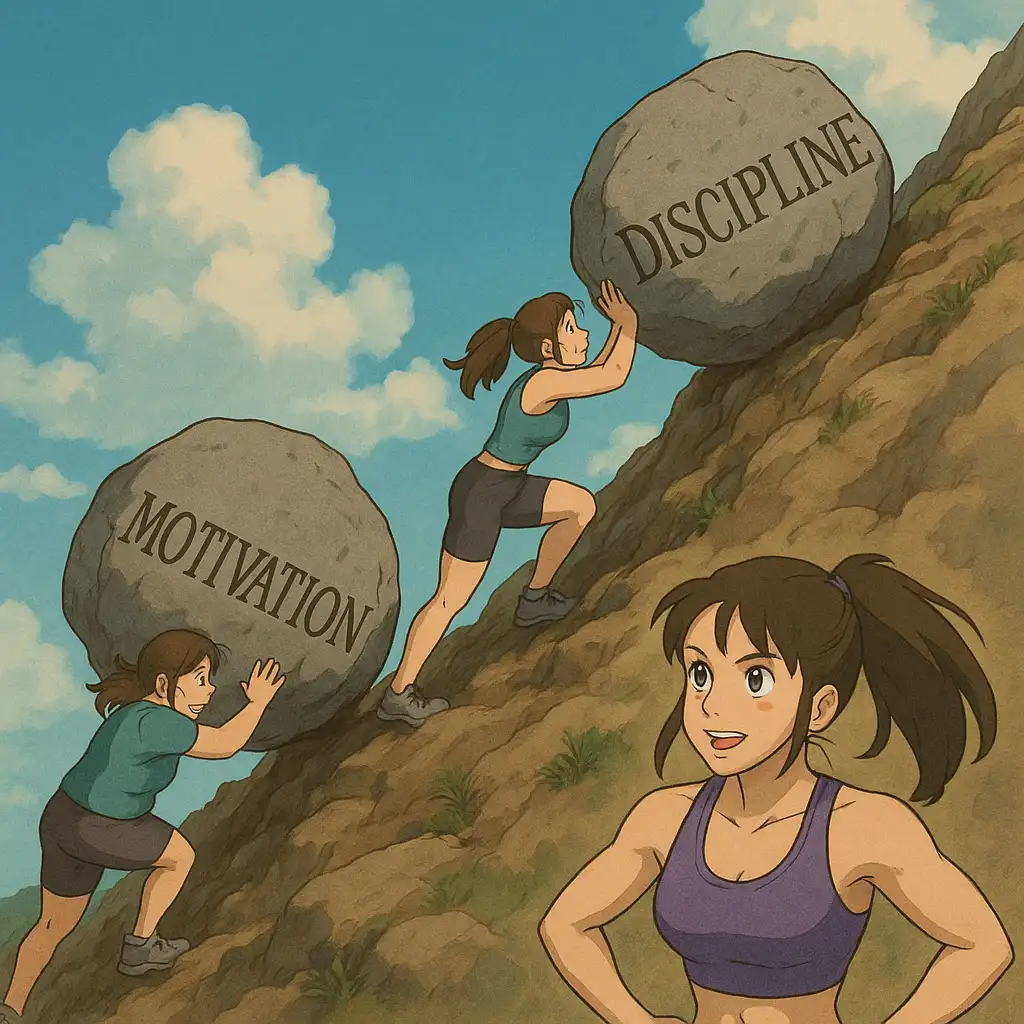
Most "get fit" attempts fail for one reason: expecting motivation to last past week three. What actually works, backed by real habit research.
Read Article