Personal trainer & software developer · Updated 2026-10-12
Written by Alberto Menéndez, certified personal trainer with 10+ years of training experience. Updated October 2026. This article summarizes the published research on creatine and hair loss. It is not medical advice — if you are noticing hair thinning, a dermatologist can tell you what is actually causing it.
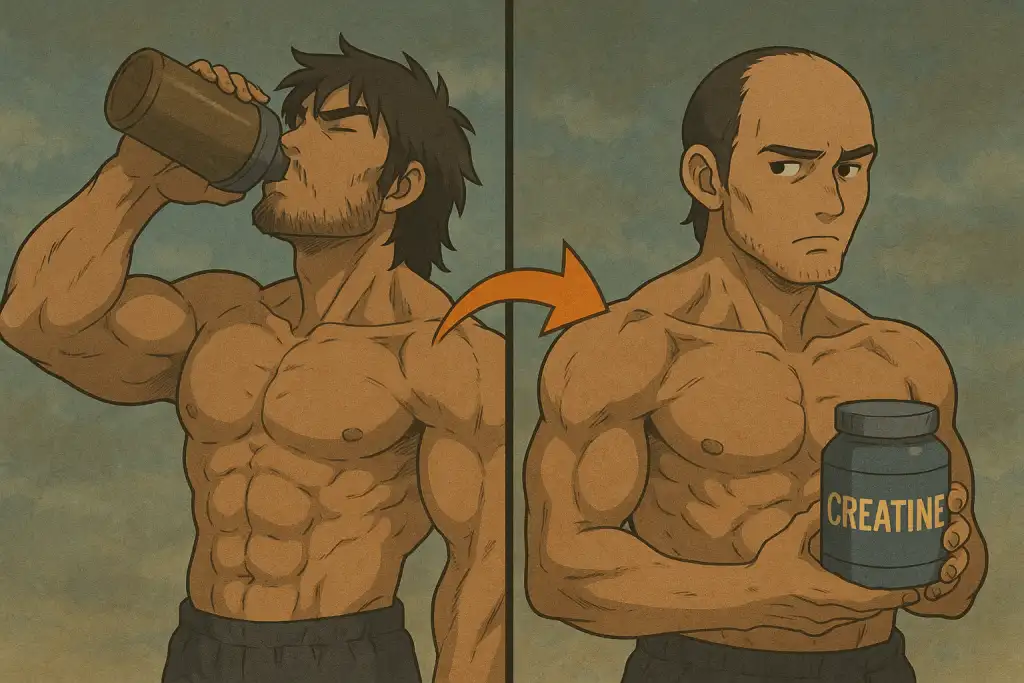
No — current evidence does not show that creatine causes hair loss. The whole idea comes from one small 2009 study that measured a rise in DHT (a hormone linked to male-pattern baldness) but never measured hair. In 2025, the first trial designed to test hair directly gave men 5 g of creatine a day for 12 weeks and found no difference in DHT or hair loss compared with placebo.
Quick answer
Creatine has not been shown to cause hair loss. A 2009 study found higher DHT levels during creatine loading, but it did not measure hair. A 2025 randomized, placebo-controlled trial that did measure hair (12 weeks, 5 g/day) found no change in DHT, testosterone or hair outcomes. If you're already losing hair genetically, creatine is very unlikely to be the cause — but if you're worried, skip the loading phase and talk to a dermatologist.
Where the Creatine–Hair Loss Myth Came From
Almost every "creatine causes hair loss" claim traces back to a single study of 20 college-aged rugby players in South Africa (van der Merwe, Brooks & Myburgh, Clinical Journal of Sport Medicine, 2009). The players took 25 g of creatine a day for 7 days (a loading phase), then 5 g a day for 14 days. The results:
DHT "increased by 56% after 7 days of creatine loading" and "remained 40% above baseline after 14 days maintenance".
The DHT-to-testosterone ratio rose 36% and stayed 22% higher during maintenance.
Testosterone itself did not change.
DHT matters because it's the hormone that shrinks hair follicles in people genetically prone to male-pattern baldness — so the headline "creatine raises DHT" quickly became "creatine makes you bald." But the study never measured hair at all, it was tiny, it has never been replicated, and the DHT values stayed within the normal range.
What the 2025 Randomized Trial Found
In 2025, researchers finally ran the study people had been asking for. In a 12-week, double-blind, placebo-controlled trial published in the Journal of the International Society of Sports Nutrition, 45 resistance-trained men aged 18-40 took either 5 g/day of creatine monohydrate or a placebo (Lak et al., 2025). Thirty-eight completed it. The researchers measured testosterone, DHT and the DHT:T ratio in the blood, and assessed hair directly with a trichogram and FotoFinder imaging (hair density, follicle count and the ratio of growing to resting hairs).
Result: no meaningful differences between creatine and placebo for any hormone or any hair measurement.
Honest limitations: it was a small study, only 12 weeks long, only in healthy young men, and it didn't screen for genetic predisposition to baldness. It doesn't prove creatine is impossible to link to hair loss in every person — but it's far stronger evidence than the 2009 study, and it points the other way.
Earlier reviews reached the same conclusion: a 2021 review of common creatine misconceptions found that most studies show no change in testosterone or DHT with creatine and that the current evidence does not support a link to hair loss (Antonio et al., JISSN, 2021).
So Why Do So Many People on Reddit Blame Creatine?
This is one of the most argued-about topics in fitness Reddit. A recent r/Supplements thread with 300+ comments asks exactly this: "I know that creatine is probably the most researched supplement ever and that every research finds no meaningful hairloss effect from creatine. But why..." do so many people report it? (r/Supplements)
The most upvoted explanation is about timing, not causation. As one r/naturalbodybuilding user put it: "No, creatine does not cause hair loss. But there is correlation, and that's because hair loss causes creatine (usage that is)." (r/naturalbodybuilding, 80+ comments) In other words, the typical creatine user is a man in his late teens or twenties — exactly the age when genetic hair loss usually starts showing. Even r/tressless, the hair-loss community, has popular threads like "Creatine Hair Loss is just Online Mass Hysteria": "There are no replicated studies that suggest creatine causes hairloss. Many people start taking creatine and assume any hairloss they experience..." is caused by it. (r/tressless)
Not everyone agrees — threads like "I'm convinced creatine causes hair loss for me" (300+ comments) show plenty of people who stopped creatine and felt it helped. Individual experiences are real, but they can't separate creatine from genetics, stress, diet changes or simple timing — which is exactly what controlled trials are for.
A Trainer's Practical Take
Creatine monohydrate is one of the most researched and effective supplements for strength and muscle. Here's how I'd approach it if hair loss is on your mind:
Skip the loading phase. The only DHT signal ever reported came during a 25 g/day loading phase. Taking 3-5 g a day from the start reaches full muscle saturation in about 3-4 weeks anyway.
Use plain creatine monohydrate. It's the form used in almost all the research, and fancier versions don't work better.
Look at family history first. If close relatives went bald early, hair loss in your 20s is likely genetic regardless of supplements.
If you notice thinning, see a dermatologist rather than guessing. Pausing creatine for a few months is a reasonable experiment if it gives you peace of mind — you'll lose some water in the muscle, not your progress.
Water weight: a 0.5-1.5 kg (1-3 lb) increase in the first weeks, mostly water stored in muscle.
Stomach upset: usually from large single doses during loading; splitting the dose or skipping loading helps.
Higher creatinine on blood tests: creatine raises creatinine, a marker doctors use for kidney function, without harming healthy kidneys. Tell your doctor you take it. If you have kidney disease, talk to them before starting.
Frequently Asked Questions
Does creatine cause hair loss?
Current evidence says no. A 2025 randomized, placebo-controlled trial found no difference in DHT, testosterone or hair measurements after 12 weeks of 5 g/day creatine. The myth comes from a single 2009 study that measured DHT but never measured hair.
Does creatine increase DHT?
One 2009 study in rugby players found DHT rose 56% during a 25 g/day loading phase and stayed 40% above baseline on 5 g/day. That finding has not been replicated, and the 2025 trial found no DHT increase at 5 g/day.
Can hair loss from creatine grow back?
Since creatine hasn't been shown to cause hair loss, thinning that appears while taking it is usually genetic or caused by something else, such as stress or diet changes. A dermatologist can identify the cause and the right treatment.
Should I stop taking creatine if I'm losing hair?
Not necessarily — the evidence doesn't link creatine to hair loss. If it worries you, pausing creatine for a few months while you see a dermatologist is a low-risk way to rule it out, and skipping the loading phase avoids the only dose ever associated with higher DHT.
References
Lak M, et al. Does creatine cause hair loss? A 12-week randomized controlled trial. J Int Soc Sports Nutr. 2025. PubMed 40265319
van der Merwe J, Brooks NE, Myburgh KH. Three weeks of creatine monohydrate supplementation affects dihydrotestosterone to testosterone ratio in college-aged rugby players. Clin J Sport Med. 2009;19(5):399-404. doi:10.1097/JSM.0b013e3181b8b52f
Antonio J, Candow DG, Forbes SC, et al. Common questions and misconceptions about creatine supplementation: what does the scientific evidence really show? J Int Soc Sports Nutr. 2021;18:13. PMC7871530
Personal trainer · Software developer · Founder of PonteFuerteAI
Over 10 years of training experience across three continents. Certified personal trainer who coached clients in Spain, India, and Japan before building PonteFuerteAI — the all-in-one AI fitness app he always wished existed.
Looking for a Hevy alternative in 2026? We compare the best apps for workout logging, AI plans, Apple Watch support, nutrition tracking, free programs, and strength progress.